|
|
|
|
|

|
|
Cash fromvarious sources including Cwmni Gwastraff Môn-Arfon (the locallandfill operator through the landfill tax scheme) CCW, is beingused to trap, examine and mark red squirrels while the greysquirrel is being controlled through trapping on private andForestry Commission owned land.
The aim is to make Anglesey red squirrel country again, thiscould take five years or longer. The red squirrel is beingdisplaced by the more robust greys who first arrived on theisland about 20 years ago.
A tiny colony of reds at Pentraeth are barely in double figures,but do represent the best chance of building up the numbers,without introducing reds from elsewhere.
The red squirrel was once common on Anglesey. Its strong hold wasthe woodlands along the Menai Strait's where it was stillfrequently seen in 1990.
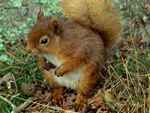
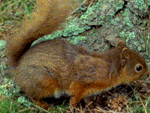
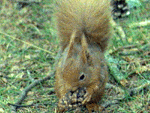
Redsquirrels are endearing, with their auburn-red fur and whiteunderbellies, bushy brown to blond tails and large fluffy red eartufts. During the winter they are highly active as they busilyseek out nuts and fungi to bury in caches. In pine forests inScotland, red squirrels spend their days dashing around in thecanopy searching for and feeding on pine cones. In deciduouswoodlands and forests they bound along the forest floor in theirsearch for fallen nuts such as hazel nuts. Although red squirrelsforage alone, they roost in communal nests during the winter.
The red squirrel constructs its nest in the branches or cavitiesof trees or stumps. In winter, it lives on food diligently storedup during late summer or autumn. A single cache may containseveral hundred spruce or pine cones.
Greysquirrels introduced to the UK have spread because they are muchmore suited to the changing habitat of our woodland. Greysquirrels can thrive on acorns and a wide variety of other foods.They also survive well in our widespread mixed deciduouswoodland. Red & Grey squirrels compete on more equal terms inConiferous woodland. So, although persecution by humans anddisease has been a threat to the red squirrel, the major reasonfor their decline is habitat loss and fragmentation.
A majordecline in red squirrels occurred in England during the 1940s and50s, corresponding to a decline in hazel crops. In southernEngland, red squirrels are only now found on the Isle of Wightand on three small islands in Poole Harbour. There are no greysquirrels on the Isle of Wight. If a grey squirrel gets acrossonto the island (e.g. on a boat) it is immediately killed inorder to preserve the red squirrel population.
The only large populations of red squirrels are in the coniferforests of Cumbria, Northumberland and Scotland. Grey squirrelsare beginning to move into these areas. There are currently anestimated 160,000 red squirrels in Great Britain; 120,000 ofthese are probably in Scotland, 30,000 in England and less than100 in Wales. In contrast, there are believed to be some 2.5million grey squirrels in Britain.
Conservationistsare trying to encourage commercial foresters and privatelandowners to maintain a mix of trees of different ages,containing plenty of Norway spruce and Scots pine which shedtheir seeds in late autumn. This would ensure that there would bea succession of mature trees producing plenty of seeds throughoutthe winter. It is advantageous to foresters and landowners toencourage red squirrels, as they do less damage to timberplantations than grey squirrels.
Red squirrels are far less rapacious and live at lower densitiesthan grey squirrels. The latter are more efficient at exploitingfood sources, and their population density is usually between 2and 8 per hectare, whereas the maximum population density of redsquirrels is fewer than 1 per hectare.
