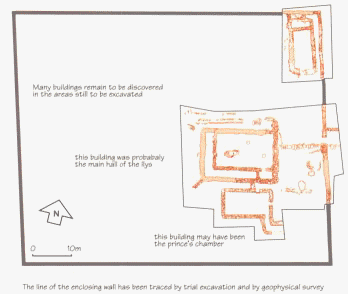
The line of the enclosing wall has been traced by trialexcavation and by geophysical survey
|
Llys Rhosyr |
|
A royal palace of the Medieval Princes of Gwynedd |
| Click here for Welsh version/fersiwn Cymraeg |
|
The excavations
Archaeological excavations began at Llys Rhosyr in 1992. Five years later, one quarter of the total area of the llys had been uncovered. Already the results exceeded the information available from any comparable site in Wales. The site is unique. The theoretical layout of the royal palaces of the Princes is known from documents, but nowhere else can the foundations of a royal llys be seen or visited on the ground. Llys Rhosyr offers an unparalleled opportunity to flesh out theory with real detail concerning the buildings, organisation and development through time of one of the major royal sites of the period of Welsh independence. |
|
The Age of the Princes
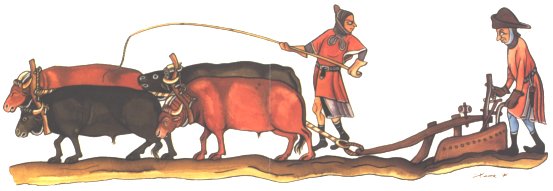
The Welsh Princes of Gwynedd, in the middle ages, developed a strong administration. In an economy unused to money, kings and other lords had traditionally taken their rent and dues as hospitality, food renders from their tenants' fields and labour services, often travelling on a circuit of their lands to extract them. All tenants paid their rents as a tithe of the produce of their fields or as labour services in carrying goods for the lord, or building works at the llys, or at the lords mill. By the 13 th century the pattern of administration is clear. The princes maintained a maerdref, or royal estate, in each subdivision of the kingdom. Here the llys with its royal halls could be found. This became the focus for the payment of rents and dues within each region. The maerdref was managed in the Princes absence by royal officials. Tenants worked the fields of the Prince's estates and other tenants provided labour services for the upkeep of the llys and the royal mills and ensured that the Prince and his entourage would be well fed. |
The line of the enclosing wall has been traced by trialexcavation and by geophysical survey
|
The Llys
The llys was at the heart of the maerdref. Here the royal halls and other important buildings could be found. It would be the residence of the Prince when he visited that part of the kingdom. Council meetings would be held and important decisions taken. Llewelyn the Great issued a charter from Llys Rhosyr in 1237. |
|
|
|
The buildings
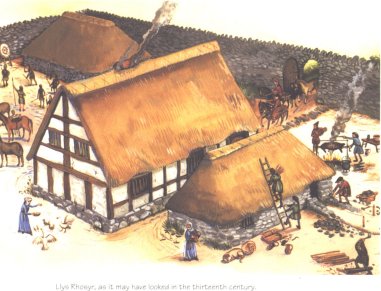
The structures uncovered so far include a large hall of at least two phases, a building standing adjacent which might have housed the Prince's private rooms and a similar construction, of uncertain function, in the north east corner. The foundations of the wall which enclosed the llys are clearly visible on the east side. The full extent of the enclosure is known to have extended over an area of 65 metres from the north to the south, by 80 metre from east to west. New stretches of wall uncovered during 1996 are particularly well preserved and stand up to 1.2 metres high. The rest of the circuit and the remaining buildings lie buried beneath the sand, awaiting excavation. A number of artefacts have been recovered suggesting that the walls enclosure and associated buildings are of the thirteenth century date and that the site was abandoned in the early years of the fourteenth century |
|
Rhosyr and Newborough
The origin and growth of Newborough is intimately linked with the consequences of the conquest of Gwynedd in 1283. Edward I determined to build a new castle and town at Beaumaris, on the Menai Straits, within a stones throw of the Welsh maerdref of Llanfaes. The community was depopulated. The burgesses were forced to move, lock, stock and barrel, across the island to a New Borough laid out to re-house them on 90 acres of Rhosyr land |
|
|
The growth of a community
Newborough received its charter in 1303. In the winter of 1320, 211 acres of land were overwhelmed by sea and sand and eleven cottages were lost. In 1352, 54 tenants held 145 properties in the new town in addition to the bondsmen who held tenancies on the former lands. This is the Newborough described in the poetry of Dafydd ap Gwilym:
Newborough town, high hopes here, its fine church and grey towers,
But a number of burgages were left unoccupied after the revolt of Owain Glyndwr.
The Prichard Jones Institute was donated to the village in 1902 by Sir John Prichard Jones. Sir John was born in Newborough and was a great local benefactor. In 1992 excavations in Cae Llys began to uncover the foundations of Llys Rhosyr, a palace of the Princes of Gwynedd. |
To order a video about llys rhosyr clickhere
|
|
Ymddiredolaeth Treftadaeth Niwbwrch Heritage Trust |
|
|
|
Contents Copyright/Cynnwys hawlfraint: Menter Môn, Cyswllt Cyf
|