

|
Kyffin Williams is considered by many to be one of the most popular living artists in North Wales. He is the last in his own line of Anglesey landed gentry. Steeped in tradition and the Church in Wales, his family, like many similar families living on the edge of aristocratic privilege, used to live a reasonably comfortable lifestyle.
Yet the mainly mountainous and marshy quality of the North Wales countryside meant that an expensive upper middle class lifestyle was sometimes frustratingly beyond his families' reach. Kyffin remembers that his father was unable to afford the £200 a year allowance to enable him to pursue a career as an army officer. Perhaps the hardship of making an 'adequate' living off the land permeated the gentry in North Wales. Kyffin remembers meeting the weather-beaten hill farmers as he joined the leisurely fox hunts on the mountains of the Ogwen valley. He remembers that there was a mutual respect between the two groups; perhaps an, albeit inadequate, economic interdependency that left both groups feeling 'on the edge', just as many of the gentry felt on the edge of the opulence of the aristocracy. It has been the uneasy images of these farmers and the harsh mountainous conditions, rather than those of the gay fox-hunters, that have dominated Kyffin's work over the past fifty to sixty years. "The fox took you to places you didn't normally go. That's how I found the mountains and the farmers. They welcomed the role of the fox hunting gentry because of their flocks. There are not so many hill farmers now. Perhaps I recorded a dying breed. I always saw the landscape and the hill farmer as the same thing. There is no word for 'landscape' in Wales. 'Cynefin' is the nearest word which denotes the relationship between the area and the people in it." Kyffin believes that to be surrounded by beauty and privilege takes away the need to be a painter. "I'm not a member of the aristocracy. They very rarely become artists. they may become writers. Toulouse Lautrec was one of the few aristocrats who became an artist and that was because he was crippled. That was his grain of sand in the oyster." Kyffin's self-image has never been a straightforward or particularly positive one. "My elder brother was very bright. I felt I was the stupid one. I got all the dirty jobs - skinning rabbits, peeling potatoes. He got a scholarship. I failed to pass the entrance exam. He always beat me at games. But he was terribly nice to me. His life was a terrible tragedy, he thought absolutely nothing of himself and just wanted to die". When Kyffin was diagnosed with epilepsy this gave him a final conviction that he should stop trying to be successful in the eyes of his family or his class. A doctor suggested that he should take up a harmless profession like painting. His decision to go to the Slade Art College in London was something of a resignation to his fate. "I was so clumsy at the Slade. The old Prof said I couldn't draw. I knew I hadn't much talent so I worked with the talent I had. For the entrance exam I made a terrible copy of Peter Scott's ducks flying over mud flats. I was told I could come for one term only. There were few men around because of the war, so he let me stay for another two terms and then a year. "I myself didn't think much of art until I had a sort of conversion in 1942 when I saw the work of Piero della Francesca and I realised there was something more to it than just reproduction. I went to the Library of the Ashburton Museum, saw a page of his Resurrection and found that I was weeping, which was a surprise to me, that art could have such an effect. It was not so much the Christian content as the spiritual power of the image. I always judge now if painters make me weep or don't make me weep." Kyffin's self-esteem was boosted when he was elected a member of the Royal Academy. As far as the 'establishment' of the modern art world is concerned, however, Kyffin's traditional approach has received very little praise or financial support. This has further polarised the division between himself and some other painters and galleries in Wales, often creating a relationship of antagonism. "Many galleries and 'modernists' are more interested in their audience response. I paint it because I like the subject matter. I'm the first Welsh artist to get through to the Welsh public. The art world has been destroyed by educationalists. Young artists haven"t been given a chance. There seems to be an expectation that an artist is of no substance if they are liked by the public. Portrait painting is considered dead because "there is no such thing as an individual". Landscape painting is seen as a mindless love of nature. All they give a damn about is their stupid theories. They destroy the art students. The problem with contemporary art is that these artists love themselves. Not what they are painting. You have got to love something. I paint from the heart." Kyffin identifies strongly with Van Gogh, whom, he says, 'loved the world'. "He and I had similar social, medical and family backgrounds (father a parson, uncle an admiral). He too had epilepsy. Vincent was a replacement child whom his mother was unable to love." Kyffin too cannot remember his mother's affection. Kyffin claims that his epileptic condition, like Van Gogh's, led to obsessional bouts of anger which were channelled into creativity. "I often painted the sea when it was rough. That could be the suppressed violence of my epileptic condition. My paintings tend to be violent. Neurotic. Because I attack the canvas and, like Van Gogh, use contrasting colours, like the light coming from behind a dark ridge." Kyffin's energy is also seen in the fact that, even at 79, he always makes a point of finishing each painting within one day. This is done he says, because the paint forms a skin after a day and to finish it before this occurs gives it a freshness. He no longer accepts commissions for portraits, as he found his apprehension before a sitting too stressful. "If I had a portrait 6 months ahead I used to get worried about it and would pray that the person would not turn up." Kyffin continues to live and work alone at his home and studio on the edge of the Menai Straits. He does not have any of his own canvases in the house - he says he does not like them! |

Gwastadnant (1971) |
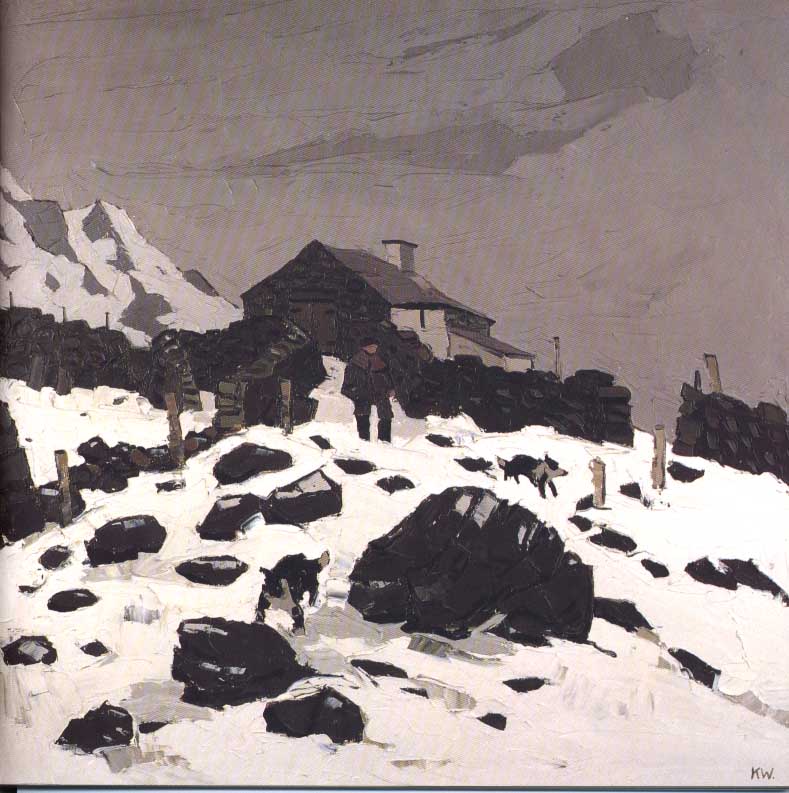
Eira yn Nant Peris (1982) |
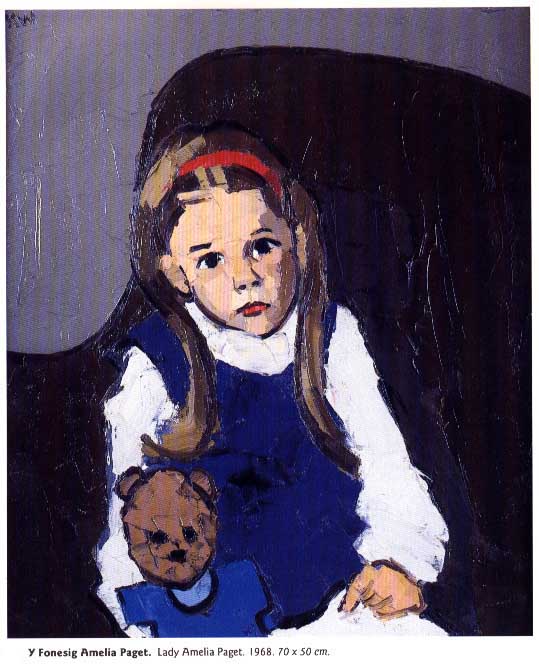
Lady Amelia Paget (1968) |

Evan Roberts (1990) |
Chwilio am ddefaid (1994) |
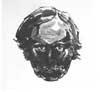
Hunan-bortread (1992 ) |
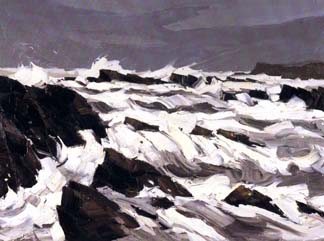
Storm, Trearddur (1987) |
Written material,unless otherwise stated, copyright
Dryw
1998-99
Artwork copyright each artist

menternet