Penysarn developed as a village at the core of Anglesey's most important mining area. From the 1760s the Parys and Mona mines, just to the west, were rapidly becoming the greatest producers of copper in the world. To the north Amlwch port was developing as a copper smelting and expotting centre. To the east speculative ventures were opened on Mynydd Eilian. Penysarn itself, was a noted clog making centre, kitting out the workers in the mine.The summit of Mynydd Eilian provides one of the most spectacular views on Anglesey. Combining breathtaking costal scenery with a landscape where the legendary past merges with some of the most important monuments of the industrial age.Cadi Rondol
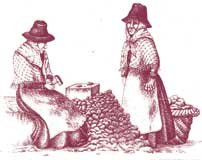
Much of the work of processing ore was done by 'coperladis' -women workers recognisable by their distinctive cothing.Another well known local lady who plied a different trade Catherine Randall. This lady of easy virtue and the best swearer around lived in a cottage now buried under the mounds of spoilThe pathways between the ponds and pits which she regularly used were known locally as 'llwybrau Cadi Rondol' - Cathy Randall's pathways. She was shown a straighter road by the great Methodist preacher John Elias.The Land of EilianThe summit of Mynydd Eilian is a patchwork of small fields bounded by stone walls and narrow lanes. Old farmhouses and cottages nestle among the craggy outcrops.Mynydd Eilian commands a prospect of all the lands that were traditionally granted to Eilian when the saint first established his religious community here in the 6th century. According to legend Caswallon Law hir, the king, undertook to give Eilian all the land that might be crossed by the running of a deer before being brought down by Caswallon's dogs. The chase began at Dulas; the deer ran to Trysglwyn - Pays Mountain - and then to Llam Carw - the deer's leap - where it left the dogs on the ciff top as it plunged into the sea. And so St. Eilian was assured one of the most beautiful corners of Anglesey.
The historic church of Llaneilian, a mile and a half to the north, preserves many interesting features. Before Llaneilian became a parish church in the 13th century, it served as the focus of a 'clas' or religious community of much earlier and, perhaps, monastic origin. The earliest stone churches on Anglesey were built in the 12th century and the unique west tower is a survival from this period. Most of the rest of the church was rebuilt three centuries later. The saint's chapel is now attached to the chancel of the church by a 17th century passage. The carved wooden screen and loft within the church are among the most interesting on the Island.St. Eilian's well on the coast nearby was famous as a place of pilgrimage in the middle ages and notorious as a cursing well.1 New Car ParkThe new car park in the village with its local history interpretation boards is the startibg point of these heritage walks.2 Parys MountainThe graetest copper mine in the worldMining on an industrial scale began in the 1760s although it was recognised as early as this that more ancient workings had taken place on the hill. The mines may have been worked in Roman times as Roman ingots of copper have been found on Anglesey but recent exploration underground and scientific dating techniques suggest that the earliest mining began in the Bronze Age, almost 3000 years ago. The heyday of the Mona and Parys mines was the late 18th century when around 1200 people were employed, one sixth of the population of Anglesey. Mining continued, both underground and in the great opencast until the 1880s when a fall in the price of copper finally closed the companies.The dramatic profile of Mynydd Parys dominates the skyline. The windmill was built in 1878 to help a steam engine pump water from one of the shafts.The large ochre ponds are clearly visible, with the sluice gates which controlled tne flow of water. Here yellow ochre settled as a deposit as the last stage in extracting copper from the water on the mountain. after drying and grinding, the ochre was used for paint. The iron rich water was also used to produce sulphuric acid in 'vitriol works' on the site. The precipitation process outlasted conventional mining of ore and was still being used as late as 1958. These remains at Mynydd Parys are unique in Britain and are very rare elsewhere in the world3 Precipitation pitsThe copper-rich qualities of the water which collected on the mountain had been recognised as early as the 16th century. Once mining started this water also became an important source of copper. The water was drawn up from the workings in buckets or, later, pumped by wind and steam power or drained directly through tunnels into a series of shallow ponds - 'pyllau helyrn' or iron ponds. Scrap iron was thrown into the ponds in large quantities until it dissolved. The chemical reaction between the iron and the copper solution caused the copper to precipitate out forming a sludge of copper at the bottom of the pits.The water was allowed to flow from pit to pit, controlled by sluice gates, so that as much copper as possible might be extracted. The sludge was then dried and smelted to produce as much as 30 tons of fine copper per year.4 The Pearl Engine House
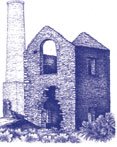
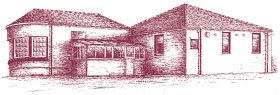
The engine house and its Cornish beam engine were built to pump water from the 600 ft Pearl Shaft of the Mona Mine. The engine may also have been used to pump a second shaft with the power transmitted by means of 'flat rods'. It was cenainly in place by 1819 vvhen the scientist Faraday visited Mynydd Parys and may have been the first Cornish engine in Wales. The boiler house, with its tall ohimney. once stood immediately behind the engine but only the foundations and collapsed spreads of stone are now visible.5 LIew LiwyfoThe memorial hall carries a plaque in commemoration of the local poet and scholar Lewis Wiliam Lewis, 'LIew LIwyfo' who died in 1901.7 The Old Telegraph Station
The Old Telegraph Station was built by the Trustees of the Liverpool Harbour Board in 1841. A chain of similar stations passed semaphore messages between Holyhead and the Mersey. giving notice of the impending arrival of ships at Liverpool. The fastest recorded message was passed, stage by stage, along the chain during a special demonstration in 1830. Within fifty years, however, the system was superseded by the electric telegraph. |