A village and it's people
The village of Pentraeth (trans. At the head of the sands) is so named because of its location at the head of the Traeth Coch sands. It is situated alongside a small river. the Afon Nodwydd, which formerly drove two mills, one for grinding corn and the other for processing wool. A number of barrows to the west of the village provide evidence of human settlement as early as the Brnnze Age, but its fame in Welsh history derives from the battle of Pentraeth in 1170. when Hywel ap Owain Gwynedd, the poet prince. was killed. There has been a community here since at least the middle ages, but its growth in the 18th century was in part due to its close association with the flourishing port of Traeth Coch, which also dates back to medieval times, and in part its location on the main road.
Shops and fairs
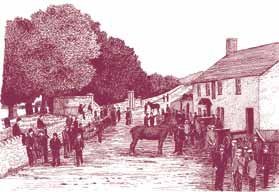
Fair day at Pentraeth was an important occasion in the local calender, when liveestock would take over the main street. Fairs were also occasaris lor purchasing consumer goods, until Pentraeth acquired its firs shop, one of the earliest in the area. around 1765. John Jones was the first shopkeeper, but it was his son Owen who developed it into a thriving business. The wide variety of goods he offered, including groceries, haberdashery and apothecary wares, were sold mainly to the more prosperous farming families, since wealthier people like the pantons brought their goods from Chester and London. Though there was much real poverty in the area, improved corn prices meant that farm wives and daughters became more fashion-conscious by the end of the eighteenth century, and it was from Owen Jones they bought their clothes.
Pentraeth People
The Battle of Pentraeth
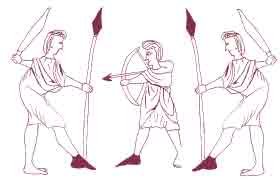
In 1170 Hywel, the illegitimate son of Owain, King of Gwynedd and of an Irish-woman named Pyfog, fought a battle at Pentraeth with his half-brothers for supremacy after their father's death, which ended with Hywel's own defeat and death. Hywel had fought with his father in the campaigns against and alongside Henry II of England, and was an effective soldier, but he is also known as a poet, who celebrated the natural beauty of his native land.
I love its sea-coast and its mountains,
Its castle by the wood, and the fine lands,
The meads of its waters, and the valleys
Its white gulls and lovely women.
I love its soldiers, its managed stallions,
Woods and strong men and homesteads.
(Hywel 's Boast of his Country, trans. Anthony Conran)
Ifor Owain Thomas
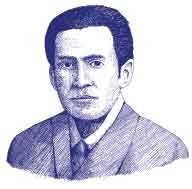
Few people enjoy careers as varied as for Owain Thomas, who was born at Pandy in Pentraeth in 1892. After winning a scholarship to the Royal College of Music and a period of further study at Paris, he made his operatic debut in Milan Dimitri in Mussourgsky's Boris Godunov, with Feodor Chaliaplin in the title role. Subsequent operatic engagements took him to Nice, Monte Carlo and New York. where he settled. and in 1933 he abruptly changed careers to become a keen photographer with Collier's Magazine. In the 1 940s he fumed his talents to painting and exhibited his work at London and New York. He was active in Welsh circles in the U.S.A., and died in 1956 after a long illness.
Dr John Jones, Deon Bangor

John Jones was born at Plas Gwyn in 1650. He was educated at Trinity College, Cambridge, and became Dean of Bangor in 1689. He was a keen educationalist, and founded and endowed at least nine charity schools in the parishes with which he was connected. He was responsible for distributing Welsh literature amongst his parishioners, and assisted in the formation of a number of libraries.
Paul Panton
Paul Panton of Plas Gwyn (1727-1797) came to Anglesey through his marriage in 1756 to Jane, daughter of John Jones the Recorder of Beaumaris. and great-niece of Dean John Jones. He came originally from Bagillt in North-east Wales. After graduating from Cambridge he became a barrister, but returned to Wales to look after his estates in Anglesey and Flintshire. He was an improving landlord, and keen to promote the latest techniques in farming. His other great interest lay in Welsh literature, despite having only a limited knowledge of the language. He was an active patron of the bards. and he amassed at Plas Gwyn a great collection of Welsh-language manuscripts, which could be visited by 'the literary portion of the community'.
1 Shops and fairs
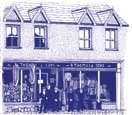
The shops around the square sustain a tradition of retailing in Pentraeth which dates back to the mid-eighteenth century. The baker's stands on the site of Hen Siop, first established around 1765, one of the earliest in the area, supplying a wide variety of goods - a tradition continued well into the twentieth century at Cloth Hall, whose billhead in 1906 advertised its proprietor, Benjamin Thomas, as "grocer, tea dealer, ironmonger, flour and corn dealer, milliner, outfitter, linen and woollen draper, bootseller and agents for all kinds of implements".
2 Panton Arms
Between the church and the Panton Arms is the original post-road across Anglesey, superseded by Telford's new road in the 1820s. In 1859 the Panton Arms was host to Charles Dickens, on his way to report on the wreck on the Royal Charter. On the opposite side of the square was the White Horse Inn, now demolished, where George Borrow, author of Wild Wales, had stayed in 1854.
3 St Mary's Church
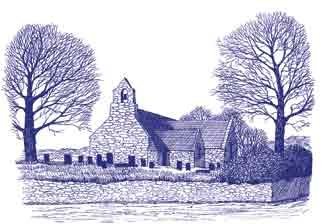
Pentraeth's parish church is shown here as it was in 1786; alterations were carried out in 1821 and again in 1882, but the nave and chancel probably date from the twelfth to fourteenth centuries. In the porch is a twelfth-century font, which has been incorporated into the wall. As well as the Church in Wales, the Calvinistic Methodists and Independents also had their own places of worship in the village. Nazareth chapel was registered for the Calvinistic Methodists in 1800 and Ebenezer for the Independents in 1809.
4 Ysgoldy
The name Ysgoldy ("Schoolhouse") recalls the school established here by the will of Dr John Jones, Dean of Bangor at whar he called "the dear place of my nativity" in 1719.
5 Buck Cottage
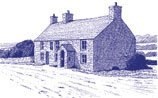
The unusual name of this house derives from the fact that it was formerly the Buck and Stag Inn, one of the seven pubs that were at one time to be found in Pentraeth.
6 The Three Leaps
In the field next to the road, on the right-hand side are three tiny piles of stones, known as "the three leaps", separated by intervals of twleve and fifteen yards. There is a tradition that these mark the spot where the 13th century poet Einion ap Gwalchmai competed for his intended wife, Angharad, by leaping further than his competitor
7 Plas Gwyn
Over the fields to the right it is possible to see Plas Gwyn, the house built by William Jones in the 1740s, and where his son-in-law Paul Panton lived. It a three-storey three-sided dwelling around a narrow courtyard, an interesting example of an English type of brick-built Georgian dwelling in Anglesey, though it has some nineteenth century additions.
8 Traeth Coch
Pentraeth was not only situated on the post road, but lay near a protected harbour, safe from the prevailing winds. Here goods were landed and stored before being taken up by horse and cart to the village, and Anglesey marble (a form of limestone) from the quarries to the south of the bay was exported. The sand from the beach was so full of sea-shells that it made an excellent manure, and was used locally as a substitute for lime.
The memorial tablet commemorates the death of Hywel ab Owain Gwynedd, the soldier and poet, in a battle with his half-brothers at Pentraeth in 1170, part of the strife that followed the death of his father, Owain, King of Gwynedd.
|