Gateway to Anglesey
There was a community in Porthaethwy in the age of the Princes. Scattered farms could be seen dotted around the landscape with the church of St. Tysilio on Church Island as a focus. There was a mill, called Melin Bach (little mill) and fisheries used man made goradau or weirs. Later, by the 16th century, the Melin Heli used the power of the tides to grind corn on Traeth Tysilio - St. Tysilios Strand.
Much of Cerrig Y Borth remained common land until the Enclosure Act of 1827 and there were few structures other than those directly concerned with the ferries at Porth Y Wrach, the Cambria and Craig Yr Halen.
By the 1780s the volume of traffic and the inconvenience of the ferries began a great debate to find an alternative. After 40 years of discussion, argument and planning Thomas Telfords design for a suspension bridge was accepted. The opening of the bridge in January 1826 brought the long tradition of ferrying at Porthaethwy to a close.
During the Victorian age, the town developed as a popular resort on the coastal steamer route. Today, Menai Bridge is a centre for Marine Studies and gateway to the historic island of Anglesey.
Bridging the Straits - Telford's Masterpiece
Two years before the deluge, there will be a bridge across the Menai
Robin Ddu, the 16th century bard, prophesied that the Menai Straits would be bridged but it took the genius of Thomas Telford to complete the task.
The Porthaethwy Ferry and others at Llanfaes, Llanidan and Abermenai had served the needs of travellers crossing to Anglesey for centuries. During the 18th century, however, the volume of traffic increased considerably. Road improvements were undertaken along the coast at Penmaenmawr in the 1720s and in 1765 the road from Porthaethwy to Holyhead was turnpiked. Coaches now crossed at Porthaethwy and despite the provision of a new hotel at the George on the mainland, the ferrymen do not appear to have risen to the challenge. Many complaints concerning the operation of the ferries were voiced locally. In 1782 a meeting of the Gentlemen of Anglesey was held at Gwyndy to consider accusations of overcharging, neglect and delay, not to mention the dangerous condition of the boats. Alternative crossings to the ferry now began to be seriously canvassed. These included plans for an embankment at Swilley Rocks or Ynys Geint and alternatively plans for stone and timber bridges. As can be imagined, with 4000 sailing ships a year passing through the Straits, objection to the proposals was strong.
The Act of Union of 1801 brought the issue of bridging the Straits to the fore again. The first Irish Mail Coach had left London for Holyhead on 3rd October 1785 and an average of two public coaches were now regularly crossing Anglesey every day. In 1810 Parliament commissioned Thomas Telford to report on the best line for a road across north Wales and Anglesey and for a bridge across the Menai. On 10th August 1819 the first stone was laid
The Father of Civil Engineering
Thomas Telford was born the son of a shepherd in a tiny cottage by the Megget Water at Glendinning, Dumfries, on 9th August 1757. He built canals, roads, bridges, aqueducts, docks and harbours throughout Britain but the Menai Suspension Bridge is widely regarded as his masterpiece. He was greatly respected by the people he worked with and drew to himself an incomparable team of engineers and craftsmen who followed him from project to project.
In 1820 while the Menai Bridge was under construction he became the first President of the new Institution of Civil Engineers. He died on 2nd September 1834, eight years after the bridge was opened.
The Bridge
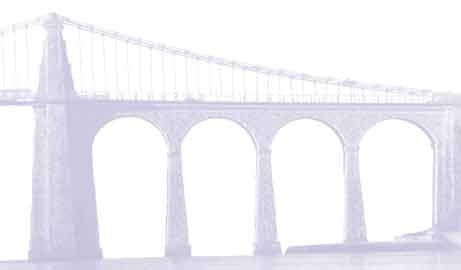
The design of the Menai Bridge, which has the carriageway suspended from chains, 100ft above high water, overcame the objections of those who saw the bridge as a possible impediment to navigation. The result was the largest bridge in Britain in its day. The technical difficulties of achieving this feat were, however, considerable and the lifting of the chains in place was perhaps the one aspect of the operation which gave Telford most cause for concern. Each chain weighed 25 tons and there were 16 chains to lift. This was achieved in the summer of 1825 to the immense relief of Telford and the great cheering of the hard working labourers. The success of the operation was rewarded with plenty of ale and substantial accompaniments ...in the disposal of which the men showed the same active zeal which had marked their previous conduct.
The total length of the bridge is 1500ft; part of which is supported by the three arched piers on the mainland side and four piers on the Anglesey side. The suspended span between the two pyramids, one of which rests on Ynys Y Moch, is 580ft. The bridge was completed and opened to the public on 30th January 1826. The first mail coach crossed at 1.30 in the morning with the resident engineer William Provis on board. The following day National flags were flown from the Pyramids and the workforce was treated to a good dinner with plenty of ale.
Between 1938 and 1941 the carriageway of the bridge was strengthened and the chains were replaced and re-aligned to meet the needs of 20th century traffic. The Bridge was freed from toll at this time and is still in use to this day. One of the original toll houses still stands at the mainland entrance to the bridge.
The Menai Straits a barrier,
a routeway and a source of livelihood
Life on the Straits
The Romans, the Normans and the English king Edward I in their turn, all found the Straits an obstacle to their ambitions. Ferries, on the other hand, have plied the Porthaethwy crossing for centuries. In addition, by the 18th century, as many as 4000 vessels a year were travelling the seaway between Aber Menai and Conwy Bay . Ferrymen, sailors and fishermen have all made their living from the Straits and many are buried on Church Island. The tides have been exploited for their power, turning mill wheels at Melin Heli, or trapping fish in man made goradau or weirs. Fish have been culled in these
traps along the shoreline for centuries. A mill called Melin Bach, perhaps tidal like the later one on Traeth Tysilio, and a
fish weir are both recorded at Porth Aethwy as early as the fourteenth century.
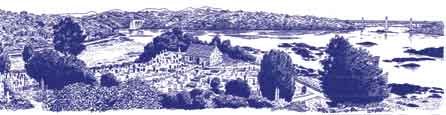
The intriguingly named Belgian Promenade was built between 1914 and 1916 by refugees from Belgium who settled in Menai Bridge at the outbreak of the First World War. The promenade was repaired in the 1960s and re-opened in 1965 by the last surviving member of the original group, Monsieur Eduard Willems of Bonheiden.
The Menai Suspension Bridge, was completed in 1826
The waters can be dangerous. The notorious Swillies were known in the middle ages as Pwll Ceris - the whirlpool described in the ninth century as one of the wonders of Ynys Mon.
In 1953 the Platters rocks claimed the old 92 gun sailing battleship, the Nile, - then in service as the sail training ship HMS Conway. She broke her back as she tried to beat the tide en route to Liverpool for refitting.
At Ynys Gorad Goch an unusual and ingenious fish trap has been created by modifying the natural features
of an island in the Straits.
Behind it rises the profile of Robert Stephensons tubular railbridge, completed in 1850. The bridge burnt
disastrously in 1970. It was rebuilt in 1973 and now carries road and rail traffic.
Ynys Tysilio
Islands in the Western Sea were special holy places of the pagan Celts and continued to be favoured by early Christians.
The small church of limestone rubble, dedicated to St. Tysilio, was built in the fifteenth century although the present building almost certainly replaces an earlier foundation. Tradition, rather than history, tells us that Tysilio was the son of the famous sixth century ruler of Powys, Brochfael Ysgythrog. Brochfael had ambitions for his son as a warrior but Tysilio had already determined on the religious life. He fled first to Meifod in Powys to escape his father and then to the banks of the Menai where he founded his church.
A memorial commemorating the dead of two world wars now crowns the highest point of the island.
1 Cerrig Y Borth
The rocky headland of was once common land. Some of the paths across it are very ancient and were used by the small, scattered population of Porthaethwy to reach the causeway leading to St. Tysilios church. In 1814 the Earl of Uxbridge, later to become Marquis of Anglesey, acquired 41 acres here and began to plant trees. This woodland later came to be known as Coed Cyrnol after a certain Colonel Sandys who lived nearby at the turn of the century.
In 1800 the main buildings on Cerrig Y Borth were still those associated with the ferry.
2
Y Felin Heli - site of the 16th century tide mill and fish weir
3
Ynys Tysilio - Historic Church Island
4
The Belgian Promenade - built by refugees between 1914 and 1916.
5
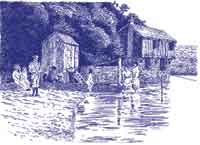
At the point where the Belgian promenade joins Beach Road there was once a very popular bathing beach with over 30 bathing huts. In the undergrowth, behind the beach, are the remains of a lime kiln which may have been used during the construction of the suspension bridge.
6
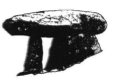
The Cromlech circle commemorates the holding of the National Eisteddfod in Menai Bridge. Telfords workshops stood on this levelled ground during the building of the suspension bridge.
The house opposite is Summer Court, formerly Menai Lodge, where Telford is said to have stayed while the works were in progress.
7
The Menai Suspension BridgeTelfords masterpiece,opened in 1826
The first ground works for the bridge were undertaken in 1818. Ynys Y Moch was levelled, quays were built and cranes were installed. Railways were laid up to the bridge foundations for the movement of materials. Carpenters and Smiths workshops, a storehouse and office were all built. Stone was quarried at Penmon and brought by sea to the quays. Limestone was burnt in kilns for mortar. There was great activity on both shores of the Straits and at the quarry and in all 200 men were at work.
8
Y Wenllys on Ffordd Cambria bears a plaque commemorating the great Welsh scholar, Sir Ifor Williams, who lived there between 1913 and 1947. Below it, on Beach road, is a tiny cottage which may be one of the few surviving buildings of the 18th century in Menai Bridge.
9
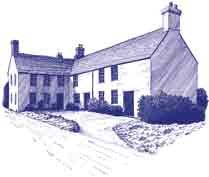
In 1686 a licence was granted for building a house for ferrymen on Porthaethwy Common. This became the Inn known sometimes as the Three Tuns but more famously as the Cambria. In 1691 fairs began to be held at Porthaethwy, on land behind the Cambria, adding to the volume of traffic which already patronised the Treborth fairs on the mainland.
10
Pier gatehouseMenai BridgeCivic Society
An Inn was built at Caer Glowr, enlarged in 1777 to become the George, and this crossing to Porthaethwy at Porth Y Wrach became the main route for wheeled vehicles.
The Ferries
The ancient ferry must have been long established when Llywelyn the Great won a victory at the passage of the Menai at Porthaethwy in 1194. The main crossing would have taken a route just east of the present bridge, landing between Ynys Y Moch and half-tide rock. But the Bishop of Bangor had his own ferry too, called Porthesgob, plying between Gorad Road, Bangor, to Cadnant and other landings. In 1188 Archbishop Baldwin, accompanied by Gerald of Wales took this route to preach the crusade to Rhodri ap Owain Gwynedd and his men, among the rocks of the shoreline.
Livestock crossed the Straits in large numbers. Smaller animals were ferried across but cattle were forced to swim. During the 17th century as many as 3000 cattle a year swam from Anglesey to the mainland. Archbishop John Williams famously described these swimming herds as the treasure galleons of Wales. By the 1790s the numbers had risen to 10000 and contemporary accounts describe the great commotion involved. The timing of the tide had to be just right.
Road improvements at Penmaenmawr during the 18th century now made it more convenient for the Irish traffic, which had crossed the Lavan Sands to Beaumaris, to cross at Porthaethwy. Coaches began to use the ferry.
The Porthaethwy ferry boats of the seventeenth century were little round sea boats holding no more than three horses at a time.
|