Where legends begin

Aberffraw is a magical place. It is remembered in Welsh bardic tradition as one of the pre-eminent tribal thrones of the island of Britain. It is here that in the mists of a mythological Celtic past that Bendigeidfran, King of the Island of the Mighty, betrothed his sister Branwen - the fairest of all maidens - to Matholwch, King of Ireland. And it was here, during the gift exchange at the wedding feast that we learn of that potent Celtic talisman, the cauldron of rebirth.
The Kingdom of Gwynedd
As the Roman Empire lost control of its western provinces, a strong independent kingdom emerged in Gwynedd - one of the most powerful in Western Britain. Gwynedd's power base was the island of Anglesey and Maelgwn, king during the early sixth century, was known as the 'Island Dragon' and regarded as among the greatest of kings. During the thirteenth century Llywelyn ap Iorwerth - the Great - gained control of all of Gwynedd. In 1230 he took for himself the title 'Prince of Aberffraw and Lord of Snowdon'. Llywelyn the Great was emphasising the link between the mountain fastness of mainland Gwynedd - strikingly visible from the dunes of Aberffraw - and the traditional, symbolic and emotional heart of the kingdom of Anglesey.
Cold heart under churning breast - keening for the king, the oak door, of Aberffraw.
In 1288 Llywelyn ap Gruffydd, 'the last Prince', was killed in the war with England. Edward 1's conquest of Gwynedd saw a new administration replace the old. The Llysoedd of the Princes no longer had a role in the governance of the kingdom and the Welsh royal lands were confiscated by the English Crown.
Maerdref Aberffraw
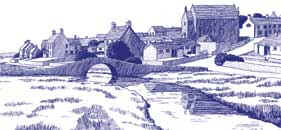
During the Age of the Princes, Gwynedd was governed from a network of regional centres. These maerdrefi took the form of royal estates, one in each commote of sub-division of the kingdom. At the heart of the maerdref was the royal llys or palace. The llys and maerdref of the commote of Malltraeth was at Aberffraw. From this base the prince's officials organised the efficient running of the maerdref and collected taxes and rents from the commote. These payments included farm works on the Prince's estate, and produce from the tenants own fields as well as carrying and building works. At Aberffraw, for example, tenants had to maintain the hall, chambers, animal house and privy and repair the walls and gate of the llys.
In 1317, one hundred and ninety eight lengths of timber were removed 'from the hall and other buildings of the late Prince Llywelyn at Aberffraw' and used in works at Caernarfon Castle. As the old llys fell into disrepair other materials must have been quarried.
Nevertheless as late as the eighteenth century it was still possible to trace the last vestiges of the Prince's palace in the south-west corner of the village. A housing estate now occupies the site.
The site
Nothing of the llys now survives above the surface of the ground but there are clues to its former whereabouts. Archaeological excavations near the centre of the village have revealed evidence of a substantial bank and ditch defence. This earthwork was refurbished long before the village took on its present form. The excavator believed that a Roman fort once stood on the rise above the crossing of the river Ffraw and that this enclosure became the focus of the early medieval llys.
'Here about anciently stood the Royal Palace of the Princes of North Wales of the Welsh Blood of which at Present Nothing remains - the stone having been carried for making Hedges and for building houses about 30 years ago'
This caption was added to an estate survey of Aberffraw in 1777
.
Trwyn Du
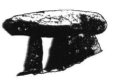
Nine thousand years ago communities of hunting and food gathering people moved across large territories in search of food. Scatters of flint flakes, the waste material from the making of barbs and points for harpoons and arrows have been found as evidence of their temporary camps along the banks of the Ffraw and at Trwyn Du. The low grass covered mound now visible is all that remains of a much later monument. Around 1700BC a grave of the Early Bronze Age was sealed by a cairn of stones. This cairn was edged by an upright kerb. The grave would have been a conspicuous landmark on the headland.
Saint Beuno's Church
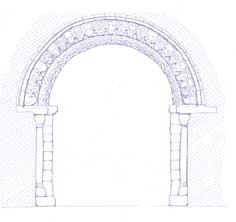
The earliest surviving features of St Beuno's church date from the twelfth century when the first stone churches were built on Anglesey. The importance of Aberffraw in earlier centuries may, however, mean that the stone church replaced a wooden one. The south door is of the fourteenth century and the north aisle was added in the sixteenth century. Many elements of the church were rebuilt in the nineteenth century. A striking and important feature of St Beuno's is the Romanesque arch in the west wall, decorated with chevrons and animal heads.
St Cwyfan's Church
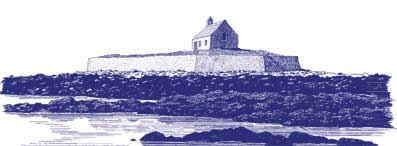
St Cwyfan's Church is dramatically set on a small island off the shore, linked to the mainland by a causeway. The church was probably built in the twelfth century. A second aisle, with an arcade, was added on the north side in the sixteenth century but this was removed nearly 200 years ago.
Llangadwaladr
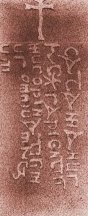
Llangadwaladr is a twelfth or thirteenth century church with a chancel added in the fourteenth century and two side chapels, of which the south was added in 1661. However, this church may once have been a royal chapel and burial ground in the court at Aberffraw. The dedication is to Cadwaladr, king of Gwynedd in the seventh century, who may have been a benefactor of the church. The memorial stone to Cadwaladr's grandfather, Cadfan, now in the nave of the church, is one of the most important pieces of evidence for the kingdom during this period. It describes Cadfan as the 'wisest and most renowned of all kings'.
|